Notion
The Notion steps connect your workflows to your Notion databases:
- The Notion trigger starts a workflow when a page is added to a database, or when a property changes.
- Notion - Write page creates a new page in a database or updates an existing one. It can also attach generated documents.
- Notion - Find pages reads the pages that match your conditions.
Use them to generate a contract when a deal moves to "Won", log every document in a database, or pull project data into a report.
Example
A consulting firm tracks deals in a Notion database. The workflow:
- Starts with the Notion trigger: Property changed, property Stage,
changed to
Won. - Generates a service agreement from the page properties with a Document step.
- Uses Write page with Update page and the condition Deal ID is Deal ID to attach the agreement to the deal's Contract files property.
Connect your account
- Add a Notion step and click Sign in under Account.
- Sign in to Notion. Choose the pages and databases TemplateDocs may access and allow access.
- You return to the workflow editor with the account selected.
Only the databases you share appear in the Database list. To share more later, share them with the integration in Notion, or open the account menu (the three dots next to the account) and choose Reconnect.
Only organization owners and admins can add or reconnect accounts. You can manage all connected accounts in your Organization Settings.
Trigger
Settings
- Account and Database - The database to listen to.
- Start when - Page added starts the workflow when a page is added to the database. Property changed starts it when a property of a page changes.
- Property (for Property changed) - The property to watch.
- Changed to (optional) - Start only when the property changes to this
value, for example a status of
Won. Leave it as Any value to start on every change. The match ignores upper and lower case.
Behavior
- The trigger listens only while the workflow is published. Draft changes apply after you publish again.
- To test before publishing, click Test in the workflow editor. You pick a page from the database, and the workflow runs with it.
- Changes made by the workflow itself (for example, by a Write page step) do not start the workflow again.
Output variables
- Page - The page the event is about: its Page ID, Page URL and one value per property.
- Event Type - Whether the page was added or its properties changed.
- Event Time - When the change happened.
- Changed Properties - The names of the properties that changed. Empty for a new page.
- Database Name / Database URL - The database the page is in.
Write page
Settings
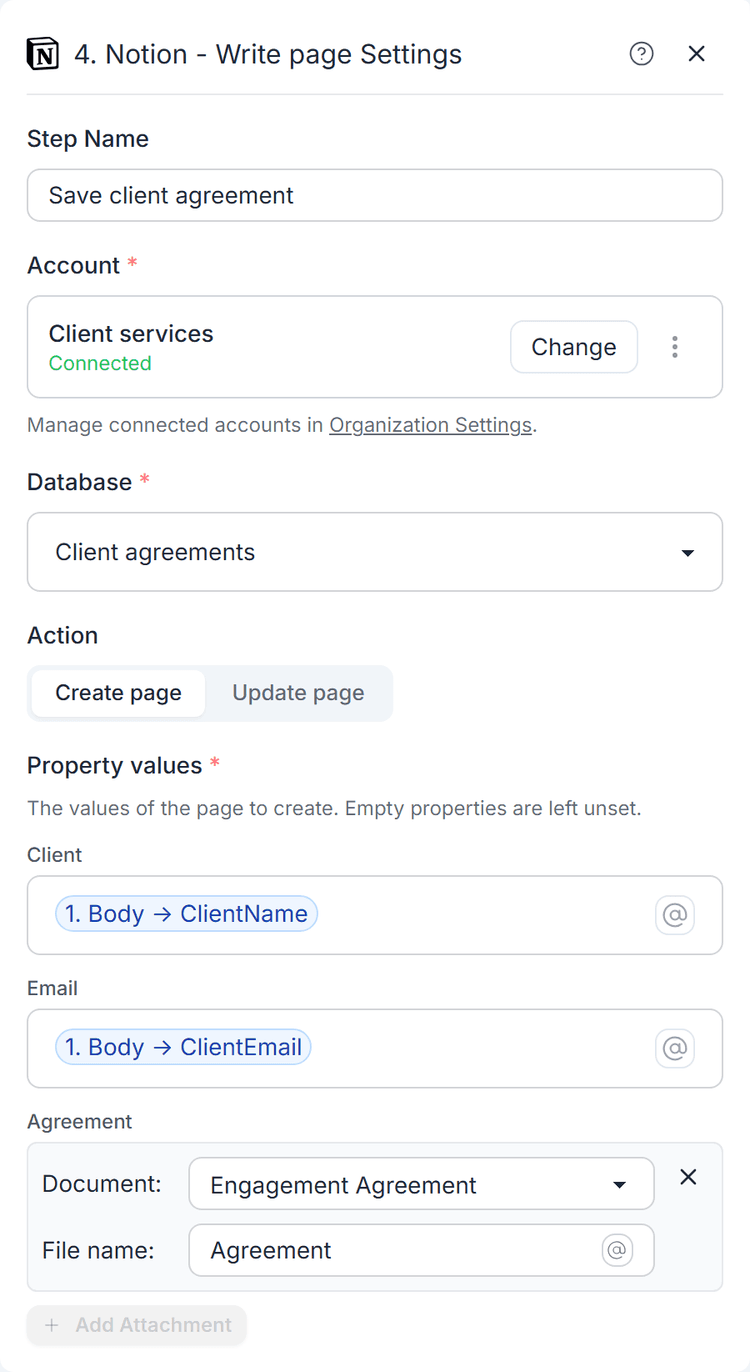
- Account and Database - Where to write.
- Action - Create page adds a new page. Update page changes an existing page.
- Property values - A value for each property you want to set. Type
@to insert variables or formulas. Date properties also let you pick a date or a date relative to today. Empty properties are left as they are.
The step can write title, text, number, select, multi-select, status, date, checkbox, URL, email and phone properties. Properties such as relations, people, formulas and rollups cannot be written.
Files properties show an Add Attachment button. Pick a document generated earlier in the workflow and set its file name. When updating a page, the uploaded documents replace the files already in that property.
Updating a page
With Update page, you also set:
- Page to update - Conditions that find the page, for example "Client ID is Client ID". Exactly one page must match. If more than one page matches, the step fails.
- If no page matches - Fail the step, Create the page, or Skip the step.
A created page also gets the values from your
isconditions, unless you set those properties yourself.
Output variables
- Page ID / Page URL - The page that was written.
- Database Name / Database URL - The database the page is in.
- Operation -
Created,UpdatedorSkipped.
Example: create a page in a client agreements database, with the client's name, email and generated agreement.
Find pages
Settings
- Account and Database - Where to search.
- Conditions - Click Add condition and choose a property, a comparison (such as is, contains, is empty or is after) and a value. Choose All conditions or Any condition. With no conditions, every page is returned. Formula, rollup and files properties cannot be used in conditions.
- Sorting - Click Add sort to order the pages by one or more properties.
- Maximum pages - Up to 1,000 pages. The default is 100.
- When more pages match - Fail the step or Return the first matching pages.
If no pages match, the step still succeeds and returns an empty list.
Output variables
- Pages - The matching pages. Each page has a Page ID, a Page URL and one value per property.
- Page Count - The number of pages returned.
- Has More -
trueif more pages matched than the maximum. - Database Name / Database URL - The database that was searched.
Map Pages to a template loop to list Notion data in a table in your document.
Credits
Each run started by the Notion trigger costs 1 credit. Each Notion step that runs (Write page or Find pages) costs 1 credit. The first 3 credits after the trigger are included in every run. See Credits.
